
Safety Alert: Vessel gangway inspection, maintenance, and operational safety – US Coast Guard 14-26

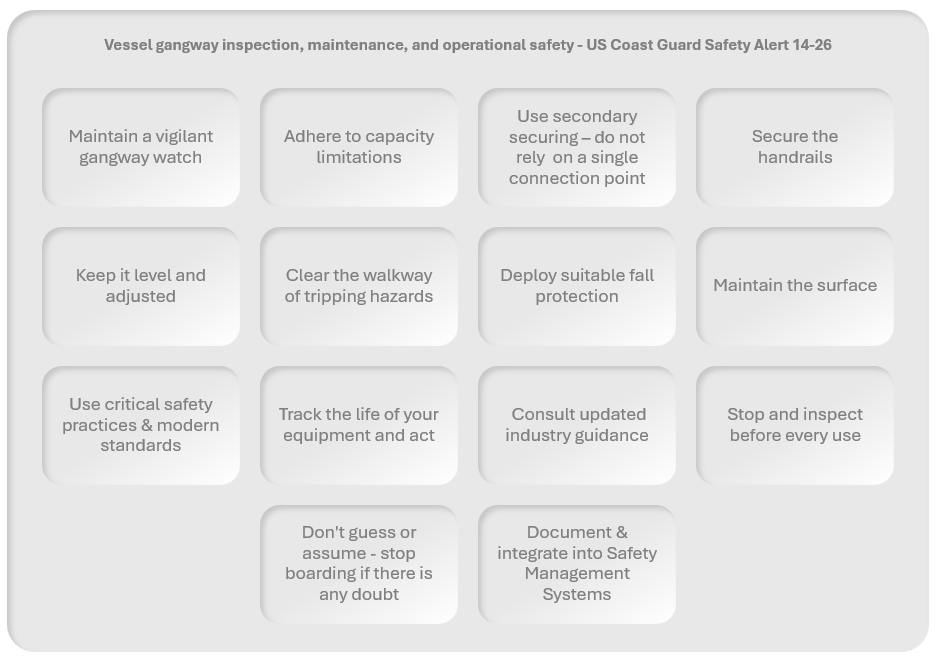
The US Coast Guard has issued a safety alert regarding vessel gangways. This follows an incident involving catastrophic failure of a gangway connection point during routine embarkation that resulted in a fatality and injuries. The alert ‘strongly recommends’ 14 key elements of gangway safety which are listed in the alert and summarised in the image shown below.
Gangway safety has been a topic at our monthly ICHCA Technical Panel Calls (ITP Calls) this year and we were able to identify 25 incidents involving failures in positioning, securing and/or condition of vessel gangways. The IMO GISIS database listed an additional 22 seafarer fatal incidents associated with use or rigging of vessel gangways.
Across the reported incidents, several common themes were identified:
- Integrity of components and securing arrangements. Repeated references to defective or unsuitable pins and fittings, particularly those prone to loosening under movement. Cases where fixings were not correctly installed or locked in place. Temporary or improvised solutions used in lieu of proper repair.
- Inspection and assurance gaps. Evidence that access equipment was used before adequate inspection. Reliance on visual checks alone, without physical verification of critical elements. Inconsistent or unclear responsibility for confirming safety prior to use.
- Interface between ship and shore. Situations where vessel-provided access was unfit for purpose, requiring shore-side intervention. In some cases, alternative arrangements introduced further risks, particularly where improperly positioned or secured.
- Positioning and stability. Gangways and ladders not correctly landed on the quay, or inadequately restrained against movement. Exposure to environmental influences (e.g. tide, vessel movement, weather), affecting stability.
- Supervision and operational discipline. Access equipment being used despite known deficiencies. Lack of effective control over when a gangway is safe to use. Limited oversight during cargo operations in proximity to access points.
- Design and equipment consistency. Indications that certain equipment configurations or component types may be associated with repeated failures, particularly across similar vessels. Variability in equipment standard and maintenance condition
Member reports suggest that formal inspection regimes are not always consistently applied prior to first use; responsibility for verifying safe access may be unclear or shared, leading to gaps; there may be a risk of unsafe conditions being tolerated operationally, particularly where there is pressure to maintain operations and short term fix remedial actions may be reasonable in controlled circumstances but the goal should be to have a strategy for engineering solutions. Some internal procedures emphasise the need for: pre-use inspections by responsible personnel, physical checking of handrails and fittings, ensuring gangways are properly grounded and within acceptable angles, preventing use until defects are corrected. However, incident evidence indicates that these controls are not always effectively implemented in practice.
ICHCA recommends that readers with potential exposure to the risk of gangway incidents, consider reviewing their gangway risk assessments and procedures as well as how their port and terminal arrangements may support the ability of the vessel to safely rig its gangways.
Link: U.S. Coast Guard Safety Alert 14-26: Vessel Gangway Inspection, Maintenance, and Operational Safety