
New ICHCA Quick Guide Makes Dangerous Goods Regulations Easier to Navigate
“Regulations are essential. Finding the right place to start can be the challenge. This quick guide helps you navigate the dangerous goods framework across air, rail, road and sea.”
The global transport of dangerous goods is supported by a complex framework of international regulations, codes and standards covering transport by air, rail, road and sea. While these requirements are essential for safety, many of the source documents are extensive, highly detailed and often challenging for non-specialists to navigate.
To help improve awareness and accessibility across the cargo supply chain, ICHCA International has published a new Quick Guide to Dangerous Goods Transport by Air, Rail, Road and Sea.
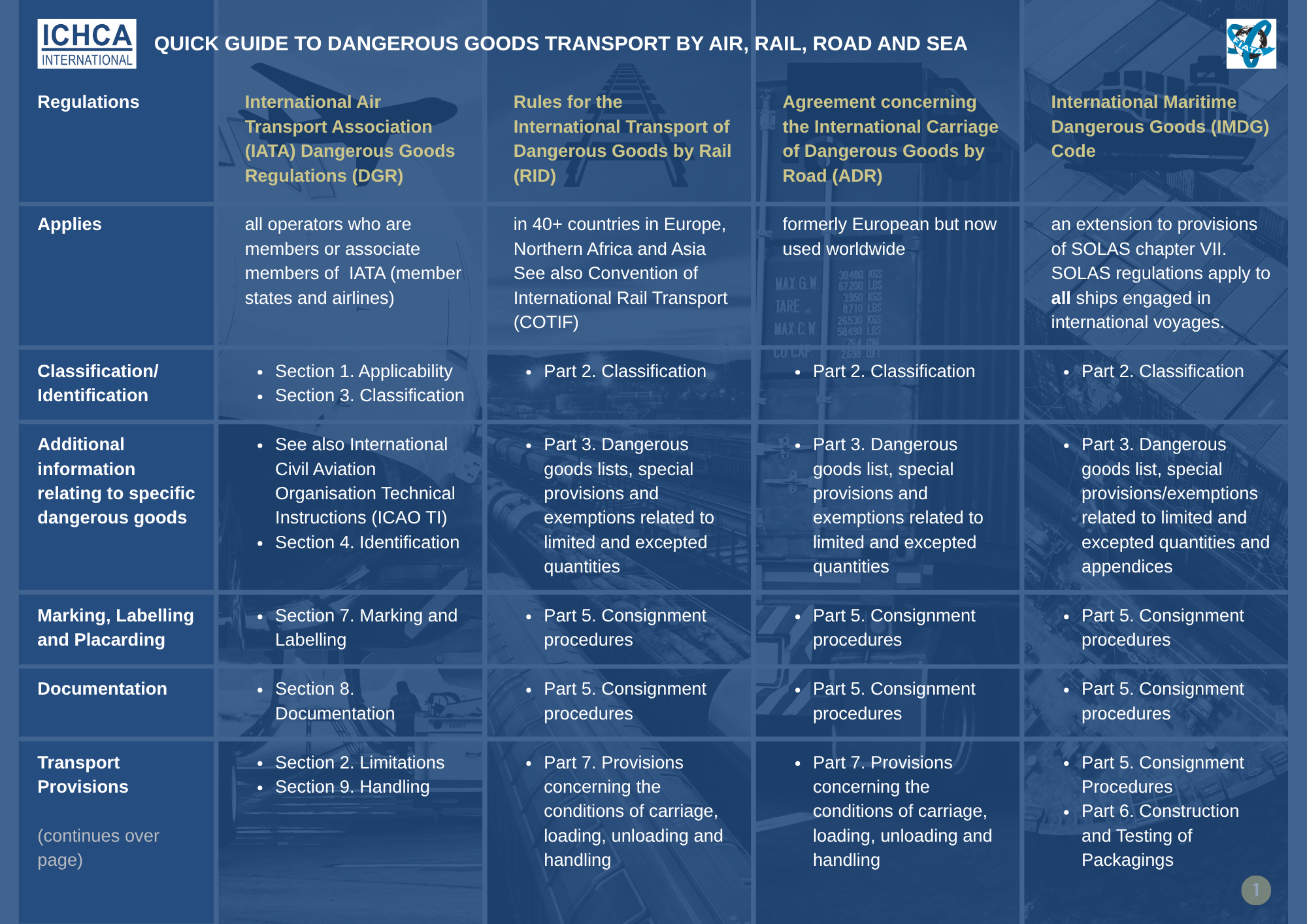
The guide provides a simple, visual reference showing where key dangerous goods requirements can be found within the principal regulatory frameworks used across the different modes of transport. Rather than replacing the relevant regulations, it serves as a practical roadmap, helping users quickly identify where topics such as classification, packing requirements, marking and labelling, documentation, packaging standards and operational provisions are addressed.
Finding your way through the dangerous goods framework
Dangerous goods move through increasingly interconnected supply chains. A single consignment may travel by road, rail, sea and air during its journey, involving multiple organisations and professionals, many of whom are not dangerous goods specialists.
Understanding which regulation applies is often the first challenge.
ICHCA’s new guide has been developed to help bridge that gap by presenting the key dangerous goods frameworks side-by-side, allowing users to identify equivalent sections and requirements across:
- IATA Dangerous Goods Regulations (DGR)
- RID (International Carriage of Dangerous Goods by Rail)
- ADR (International Carriage of Dangerous Goods by Road)
- IMDG (International Maritime Dangerous Goods Code)
By simplifying access to this information, the guide supports greater awareness of dangerous goods requirements throughout the supply chain and encourages the consistent application of good practice.
Practical uses for members and industry stakeholders
The guide has been designed as a versatile resource that can be used in a variety of operational and training environments.
Potential applications include:
- desk-side quick reference for operational personnel.
- introductory awareness tool for employees new to dangerous goods.
- resource for internal training sessions and refresher programmes.
- discussion aid during safety meetings, toolbox talks and pre-work briefings.
- reference document for managers and supervisors who need an overview of regulatory requirements but are not dangerous goods specialists.
- useful guide for organisations operating across multiple transport modes.
- support tool for improving communication between shippers, freight forwarders, carriers, terminals, warehouses and regulators.
Supporting safer supply chains
Safe transport of dangerous goods depends not only on compliance specialists, but also on wider awareness among everyone involved in cargo operations.
By making the structure of the major dangerous goods regulations easier to understand and access, this guide can help organisations strengthen competence, support training initiatives and promote a stronger safety culture throughout the supply chain.
Download the guide
Quick Guide to Dangerous Goods Transport by Air, Rail, Road and Sea
Coming soon
This publication is the first in a series of practical dangerous goods reference tools from ICHCA. A companion guide focusing specifically on dangerous goods training requirements across the different transport modes will be released shortly.
ICHCA encourages members and industry stakeholders to share these resources within their organisations to help raise awareness and support the safe and efficient movement of dangerous goods worldwide.